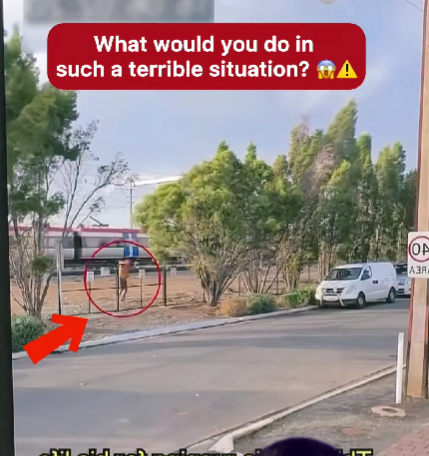
At first, it seems like any ordinary street: cars resting quietly along the curb, trees moving gently in the breeze, and nothing that hints at danger.
But a closer look at the photo now making rounds online reveals something entirely different—an unsettling detail that has left many viewers uneasy and asking the same chilling question: What would you do if you were there?
The image feels like a moment suspended in time. A red circle draws attention to a small yet troubling element near the edge of the road—something many admit they completely overlooked at first. But once it’s noticed, you can’t unsee it. People reacting to the photo describe a jolt of fear, followed by disbelief that such a situation could sit unnoticed in plain sight.
Information is still scarce, and officials have not provided the full story behind what the picture shows. That lack of clarity has only intensified the public’s reaction. Some believe the snapshot hints at someone who may be in danger. Others worry it suggests abandonment, neglect, or a scenario where immediate assistance might be necessary. The one shared sentiment: something about it feels seriously wrong.
Comments online show how differently people respond in moments like these. Some say they would instantly contact emergency services. Others admit they’d hesitate, unsure whether their interpretation was accurate. That hesitation, specialists note, is more common than most people realize.
Psychologists call this the “bystander effect”—the tendency to delay action because we assume someone else will step in, or because we fear misreading the situation. In quiet, everyday environments, the mind often resists the idea that something critical could be happening right in front of us.
What makes this photo especially eerie is the normalcy of the setting. No chaos, no visible alarm, no crowd gathering. And that’s exactly why it hits so hard. Many urgent situations don’t arrive with noise or drama—they linger silently, waiting for someone to recognize the signs.
Safety advocates stress the importance of trusting your instincts. If something feels off, it usually is. Reaching out for help—even if it ends up being a false alarm—is almost always better than staying silent and wondering later whether action might have made a difference.
At the same time, experts urge people to be cautious about sharing images without confirmed facts. While viral posts can raise awareness, they can also spread confusion or spark unnecessary fear. The key is to stay alert without jumping to conclusions—attentive, but responsible.
As conversations continue, the image has sparked a broader reflection about personal responsibility. In a world where everyone can easily record and share moments, seeing isn’t the challenge—deciding what to do is.
And that leaves the lingering question, one that stays with you even after scrolling past:
If you were driving down that quiet street… if your eyes caught that small, unsettling detail… what would you do?
Sometimes the most defining moments offer no clear guidance—only a choice.
About the Author